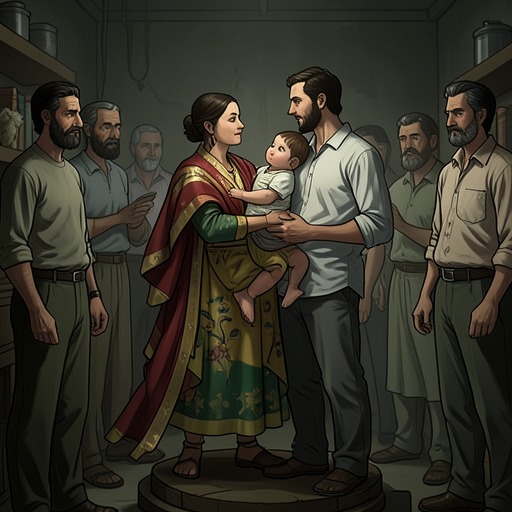
Relationship between Alexander Gideon and Boaz Brandstetter
Black BoxThe relationship between Alexander Gideon and Boaz Brandstetter is defined by a contradiction: Alexander’s care for the boy is real, but for years it remains hidden behind estrangement, legal conflict, and an inability to take responsibility directly. Their eventual closeness comes not through a simple reconciliation but through reversal. The father who once feared that a court might place the child in his custody returns to a home where the son helps sustain him in illness.
Paternity and the divorce
Boaz’s place in Alexander’s life was contested from the beginning. During the divorce proceedings, Alexander insisted that he was not Boaz’s father. A blood test did not resolve the question, and the Jerusalem District Court advised both parties to undergo tissue testing. Neither agreed. Ilana Sommo later explained that she refused because she feared that proof of paternity would allow Alexander to obtain custody. She wanted financial support, she said, but not at the cost of losing her eight-year-old son. The proceedings ended with her withdrawing her maintenance claim and both parties declaring that they had no further demands on one another.
The Rabbinical Court’s decision recorded an adultery admission and ruled that Ilana forfeited her ketubah and maintenance. The legal record thus joined questions of marriage, money, and paternity, while leaving the central biological question unsettled. Years later, Alexander returned to that unresolved point in a letter, asking why Ilana had resisted the test and whether she had suspected what it might show. His questions expose how little either had told the other at the time: Ilana had acted to protect her relationship with Boaz, while Alexander had treated the dispute as a contest whose legal outcome might determine his rights as a father.
Alexander’s own later account complicates Ilana’s fear. He said that he had not wanted Boaz taken away to live with him and did not know what he would have done with the boy. He imagined that a court order might have attached the child to him, but questioned what Boaz’s life would have become in his care. The two accounts do not cancel each other: Ilana feared that Alexander would use custody to separate her from her son, while Alexander later admitted that he had neither wanted nor felt capable of raising him.
Concealed care and remembered childhood
When Boaz developed a kidney infection at eight, Alexander secretly consulted Dr. Blumenthal about whether an adult could donate a kidney to a child. He was prepared to offer one of his own, on the strict condition that Ilana and Boaz never learn of it. Ilana eventually discovered the plan through Dr. Adorno, an assistant whom Alexander was preparing to sue over Boaz’s treatment. Boaz recovered without a transplant. Alexander then expelled Ilana and the child from his house and life; the donation remained an unrealized intention, known to Ilana only years afterward. She regarded the plan as evidence that Alexander had seriously meant to protect Boaz, even though he had not allowed that care to become a shared act between father and son.
Alexander’s later letters also reveal that the estrangement was not ignorance. He said that Manfred Zakheim and private detectives had sent him reports on Ilana and Boaz throughout the years, and that he knew of Boaz’s violence. He nonetheless distinguished the boy from the adults around him, describing him as a growth separate from his parents’ failings. His attention from a distance did not repair the relationship, but it contradicts the appearance of complete indifference.
A recollection of Boaz’s childhood makes the distance more painful. Alexander remembered the boy’s habits and inventions, their games, and an episode in which Boaz intervened during a violent confrontation between his parents. Alexander recalled that he might have killed both Ilana and Boaz and then himself. The memory does not establish an easy paternal bond; it shows how protection, danger, and family life had become entangled. Even so, the detail that remains with him is the child’s attempt to stop the harm, a moment that Alexander carries into the later question of what he and Ilana had seen in their son.
Estrangement, money, and indirect contact
After the divorce, Alexander’s relationship with Boaz proceeded largely through reports and financial interventions rather than ordinary contact. When Boaz later encountered trouble, Ilana initially wrote to Alexander for help while concealing that she believed Michel Sommo would be the person to rescue the boy. She admitted that the information in her letters was accurate but that her appeal had also been a trap: she wanted to draw Alexander back into communication. In her view, Michel knew how to act, while Alexander’s practical reach depended on money, telephone calls, and influential contacts.
Alexander did provide money, and the later account says that his funds, together with Michel’s judgment and the help of the Sommo family’s friends, helped get Boaz out of trouble and close his police record. This assistance mattered, but it did not amount to a renewed father-son relationship. Boaz came to visit the Sommo family, and Michel gradually found a way toward him; Alexander remained outside those domestic scenes. Ilana’s account draws a pointed distinction between Alexander’s contribution and Michel’s presence: one could help from a distance, while the other had to build a relationship with the boy.
The correspondence itself is part of the relationship’s history. Ilana acknowledged that she had deceived Alexander during their marriage in attempts to reach him, and that her renewed deception was directed toward the same end. Alexander, in turn, asked whether her changed position on tissue testing was genuine and whether money was now driving her appeal. Neither parent’s version is wholly free of self-interest. Their letters gradually disclose not only what happened to Boaz but also the ways his parents used silence, legal claims, and money to avoid or manage the demands of direct attachment.
Return and reversal of dependence
Alexander returned to Israel after learning that he had advanced kidney cancer and that his life was nearing its end. He had undergone two operations, and the growth had spread through his abdomen. He said that the illness had brought regrets and prompted him to come back, see Boaz, and stay in the house where he had grown up. By then, the house was understood to belong to Boaz, although it remained registered in Alexander’s name. That distinction gives the return a material as well as emotional dimension: Alexander came back to a family home whose future was tied to the son he had once refused to acknowledge through a test.
Boaz’s household had begun to restore the neglected property. Young residents cleared the garden and planted vegetables where Alexander’s father had grown ornamental roses. Boaz made a walking stick that helped his sick father move around. These changes place Alexander within a life Boaz had built rather than restoring the paternal authority Alexander once might have claimed. The son’s work, and the house’s altered use, become the setting for a relationship that can now develop only under radically changed conditions.
The change becomes clearest in the daily care Alexander receives. Boaz made him a resting place from eucalyptus branches and carried him upstairs to bed, handling him carefully and quietly. Alexander, once the adult who might have become Boaz’s donor and guardian, was now physically dependent on the son whose custody he had never pursued. The evidence does not show a formal reconciliation or a spoken settlement between them. It shows care enacted through practical gestures, while Ilana assumed much of the nursing and Alexander’s illness narrowed the time available to them.
What remains unresolved
The relationship’s ending is therefore a movement toward intimacy without a final declaration. Alexander’s concealed willingness to donate a kidney shows a form of paternal concern that he withheld from the people it concerned; his later return makes that hidden concern visible, but cannot undo the expulsion or the years of silence. Boaz’s assistance reverses their earlier positions without erasing the history that produced their distance.
The story refuses to make biological proof the sole measure of fatherhood. The tissue test never settled paternity in court, and Alexander’s own later uncertainty about custody sits beside the evidence of his secret offer and continued watching from afar. In the final phase, the most concrete bond is neither legal nor genetic: Boaz builds for Alexander, carries him, and helps him return to the house. Their connection becomes tangible only when Alexander can no longer control it through a court case, a check, or distance.